Navigating the “Dark Web”.
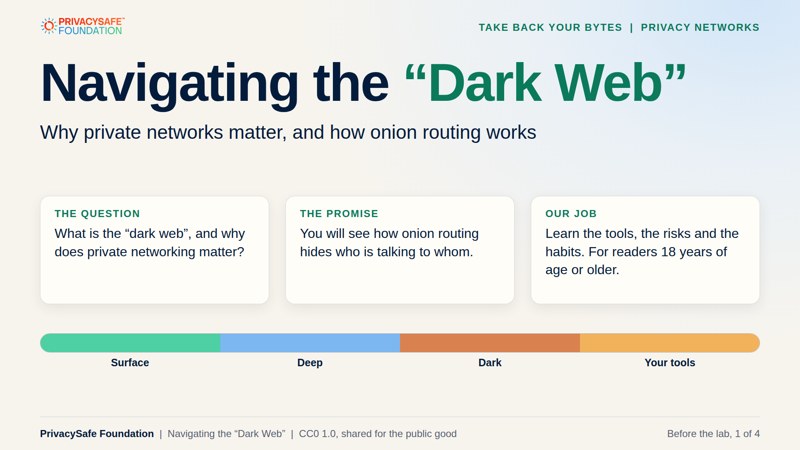
A Take Back Your Bytes lesson for adults: what the “dark web” really is, why onion routing matters, and how to stay safe.
The whole lesson in under five minutes. Captions are on the picture and music is built in. Press the speaker button for sound. Also available: the dark version for projecting and subtitle files for the light and dark videos.
Three layers of the web
Surface web   pages that search engines index
Deep web      pages behind a login: email, banking, cloud files
Dark web      sites that need special software: Tor and I2P
The name sounds sinister. The technology is neutral. It hides where a connection comes from and where it goes, which reporters, activists and ordinary people rely on.
Welcome. Let’s take the mystery out of the “dark web”.
Most people have heard the term and few know what it means. In plain terms, it is a label for sites you can reach only with special software, most often Tor or I2P. Those tools were built to protect privacy and free expression. They hide where a connection comes from and where it goes, which is why reporters, sources, activists, researchers and ordinary people use them.
This lesson looks at how onion routing works and why it matters, then compares Tor, I2P and VPNs. A VPN is only a quick comparison: when you use one, you put ultimate trust in a single company, so choose a paid service from a company you have researched. Running servers costs money, and a free service has to pay for itself somehow, sometimes with data about its users. We recommend no provider.
A fair warning: like all of the web, private networks are not curated. You can stumble across things that may not be legal and may be upsetting. We do not host, run or endorse other sites, and we ask you to know the laws where you live, use judgment, and leave anything that troubles you. If you come across child sexual abuse material, leave at once and report it to the CyberTipline in the United States, or to your national hotline or law enforcement elsewhere.
Make a prediction. Before the lab you’ll be asked: in a Tor circuit, which single relay knows both who you are and which site you asked for? Write down your answer. The lab shows it.
Follow the session in order.
Learn the ideas, try the lab, then make your own safe-browsing plan.
2. The onion routing lab
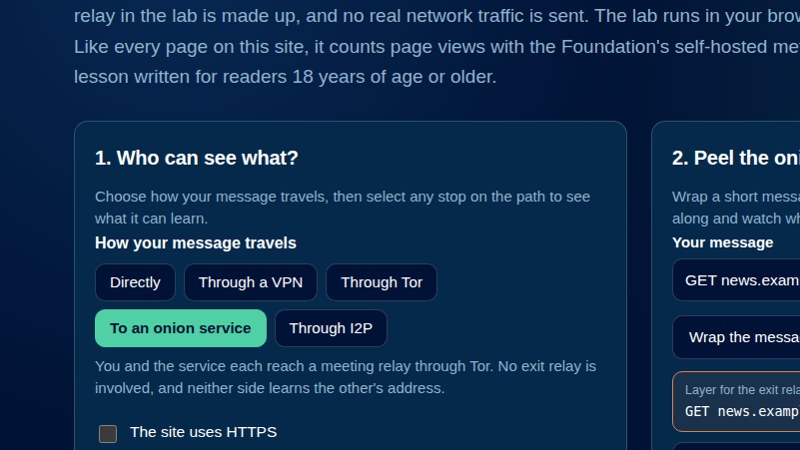
Runs in your browser Compare direct, VPN, Tor, onion service and I2P paths, peel the layers of an onion, choose a tool, and build a plan. Open the lab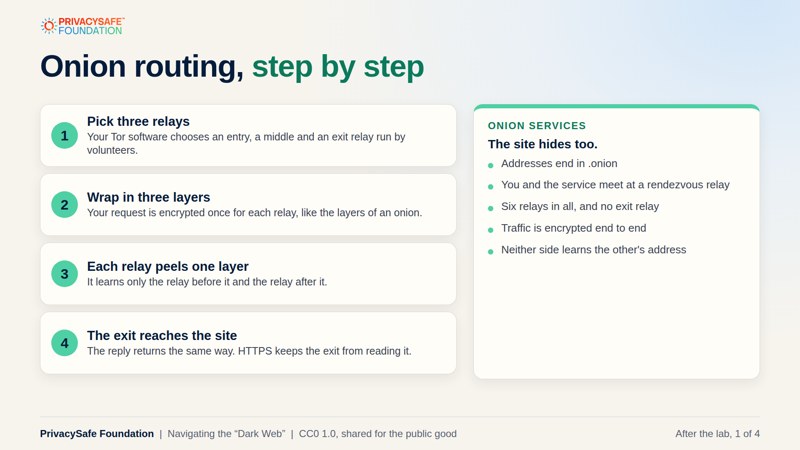
3. After the lab
PDF, 4 slides Onion routing step by step, Tor and I2P compared with VPNs, why anonymity matters, and a plan with discussion questions. Open the slides (light)What you will learn.
How private networks work, why they matter, and how to use them wisely.
What the “dark web” is
The surface, deep and dark web, why the name is loaded, and the fair warning that goes with any part of the web.
How onion routing works
Three relays, three layers, and onion services that hide both ends. Then I2P, VPNs, and who you must trust in each.
Free speech and good habits
Why anonymity supports freedom of expression, real-world onion sites to explore, and a plan for lawful, careful use.
Where to go next.
Examples, not endorsements. Check each organization's own pages for current details.
Tor and Tor Browser
The Tor Project makes Tor Browser and explains onion services. Start at torproject.org and use its user manual.
I2P
The Invisible Internet Project describes how its network works and how to run a router. Start at geti2p.net.
Real-world onion sites
A list of mainstream sites that also offer onion services, such as BBC News, Deutsche Welle, ProPublica, The Guardian, DuckDuckGo, Proton Mail and Debian. Find current addresses in the real-world-onion-sites list, and check an address against each site's own announcement.
PrivacySafe Search and Bot
PrivacySafe Foundation runs PrivacySafe Search and PrivacySafe Bot. Both can be reached through Tor at a .onion address, which each site publishes.
PrivacySafe.app
The PrivacySafe.app apps for desktop and smartphones give you end-to-end encrypted Chat, Inbox, Storage and Contacts. They protect what you say and share, and they can be used over Tor and I2P to hide where you connect from too. The apps are published by Ivy Cyber, the Foundation's commercial partner.
Free speech and privacy
Article 19 of the Universal Declaration of Human Rights protects the freedom to seek, receive and impart information, and anonymity and encryption help people exercise it.